> For the complete documentation index, see [llms.txt](https://kb.logicerp.com/llms.txt). Markdown versions of documentation pages are available by appending `.md` to page URLs; this page is available as [Markdown](https://kb.logicerp.com/logic-erp-version-release-notes/november-2019/general/how-to-allow-access-to-sql-server-on-network.md).
# How to allow Access to SQL Server on Network?
After installing the SQL Server Database Engine & Management Studio, the next step is to allow access to SQL Server on Network. To enable access to the SQL server on the network, follow the given steps:
**Step-1** Open SQL Server 2017 Configuration Manager.
**Step-2** In the ‘SQL Server Network Configuration’, open “**Protocols for SQLEXPRESS**. You have to enable both, **Name pipes** and **TCP/IP** protocols. **Shared Memory** is by default enabled.
**Step-3** Next step is to enable TCP/IP protocol as shown in the picture below:
After setting Enabled option to Yes, go to IP Addresses settings. Here, set the **TCP Port** of **IPAII** to **1433**.
Click on **Apply** and **OK** button to save the changes.
**Step-4** Although the changes are saved, they will not have any effect until you stop and restart the SQL Server Services. For restarting the services, go to the **SQL Server Services** option.
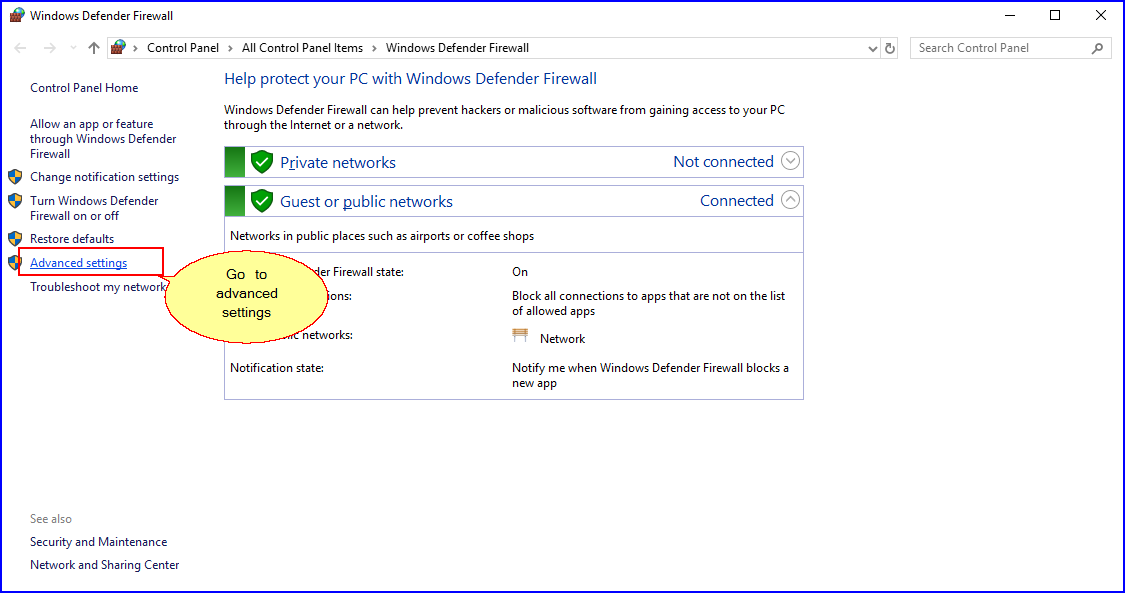
**Step-5** Open Windows Defender Firewall. Go to the **Advanced Settings**.
**Step-6** Go to Inbound Rules. Click on **New Rule**.
**Step-7** New Inbound Rule Wizard will open. In the **Rule Type** section, select the **Port** option. Then Click on **Next** button.
**Step-8** In the Protocol and Ports section, enter the Specific Local TCP port number i.e., **1433**. It means that the rule will be applied to the specific TCP ports.
Click the **Next** button to proceed.
**Step-9** Select “**Allow the Connection**” option as Action type and click on **Next** button.
**Step-10** Select **Domain**, **Private**, & **Public** options in the Profile section. Click the **Next** button to proceed.
**Step-11** Enter **Name** of the rule. You can also specify the description.
Click the **Finish** button to save the rule.
**Step-12** In the Windows search bar, search for **Services**. Then, Click to open the Services.
**Step-13** In the **SQL Server Browser** set the **Startup Type** to **Automatic**.
Also, copy the program path mentioned in “**Path to executable:**” option. Make sure to save it in notepad or MS-word.
**Step-14** Now again go to the Inbound Rules and create New Rule.
Select **Program** as Rule Type and click on **Next** button as shown in the figure below:
**Step-15** Paste the program path that you copied in the **Step-13**, or you can browse it also.
**Step-16** Select “**Allow the Connection**” option as Action type and click on **Next** button.
**Step-17** Select **Domain**, **Private**, & **Public** options in the Profile section. Click the **Next** button to proceed.
**Step-18** Enter **Name** of the new rule. You can also specify the description.
Click the **Finish** button to save the new rule.
---
# Agent Instructions
This documentation is published with GitBook. GitBook is the documentation platform designed so that both humans and AI agents can read, navigate, and reason over technical content effectively. Learn more at gitbook.com.
## Querying This Documentation
If you need additional information that is not directly available in this page, you can query the documentation by asking a question.
Perform an HTTP GET request on the following URL with the `ask` and `goal` query parameters:
```
GET https://kb.logicerp.com/logic-erp-version-release-notes/november-2019/general/how-to-allow-access-to-sql-server-on-network.md?ask=&goal=
```
`ask` is the immediate question: it should be specific, self-contained, and written in natural language.
`goal` is what the user is ultimately trying to achieve, the reason they need the answer. Sharing it helps GitBook give you a better, more relevant answer. A goal is most helpful when it describes the outcome the user wants rather than restating the question. For example, with `ask=how do I create an API token`, a goal like `automate deployments from our CI pipeline` lets GitBook tailor the answer to that use case.
The response will contain a direct answer to the question and relevant excerpts and sources from the documentation.
Use this mechanism when the answer is not explicitly present in the current page, you need clarification or additional context, or you want to retrieve related documentation sections.