# Default Quantity As

**YouTube:** [How to Set a Default Value for the Quantity Field in Sale Bill ?](https://www.youtube.com/watch?v=PniUgnNcMXQ)

## How to Set a Default Value for the Quantity Field in Sale Bill?

In this tutorial, we'll explore a powerful feature that allows you to predefine item quantities during billing using various configuration options, including current stock and custom item fields.

***

### **Step-by-Step Guide:**

* Navigate to the **Sales Voucher Configuration** window.
* Select the **relevant billing series** where the configuration needs to be applied.
* Locate the option labeled: **“Default Quantity As”** Under the **"Other Settings-2".**
* It includes **Six Parameters** to set Default Quantity.
  * None
  * One
  * Item Cf-1
  * Item Cf-2
  * Item Cf-3
  * Current Stock

<figure><img src="https://4031188996-files.gitbook.io/~/files/v0/b/gitbook-x-prod.appspot.com/o/spaces%2FXMVkjt8zqHBQX1c9QvFS%2Fuploads%2FwYIWu5tnF0hq5r8aH1Fs%2FSetup.png?alt=media&#x26;token=26b65bb6-3660-4c07-9d61-1f9e7416a153" alt=""><figcaption><p>As mentioned above, follow the given steps and select the appropriate option from the dropdown as per your requirement.</p></figcaption></figure>

***

### Comprehensive Breakdown of Each Available Option

* **None**
  * The quantity field remains **blank or zero** by default.
  * The user must **manually enter** the quantity during transaction entry.

<figure><img src="https://4031188996-files.gitbook.io/~/files/v0/b/gitbook-x-prod.appspot.com/o/spaces%2FXMVkjt8zqHBQX1c9QvFS%2Fuploads%2FNK4B5WNodG53g2gxC2Wm%2FNone.png?alt=media&#x26;token=b0748463-e7db-469b-9684-846ed761248f" alt=""><figcaption><p>In this picture, the functionality of "NONE" has been illustrated.</p></figcaption></figure>

* **One**
  * The system will **automatically default the quantity to 1** for every item during transactions.
  * Useful for single-unit transactions or high-turnover items.

<figure><img src="https://4031188996-files.gitbook.io/~/files/v0/b/gitbook-x-prod.appspot.com/o/spaces%2FXMVkjt8zqHBQX1c9QvFS%2Fuploads%2FL5XvL2sqzeekmBcQinkF%2FOne.png?alt=media&#x26;token=a753add7-1367-4dc2-abcb-7c676a316132" alt=""><figcaption><p>In this picture, the functionality of "One" has been illustrated.</p></figcaption></figure>

* **Item CF One (Conversion Factor One)**
  * The system fetches quantity from **CF1 (Conversion Factor 1)** defined in the **Item Master**.

<figure><img src="https://4031188996-files.gitbook.io/~/files/v0/b/gitbook-x-prod.appspot.com/o/spaces%2FXMVkjt8zqHBQX1c9QvFS%2Fuploads%2F3c6PlpISoQvrmPR2muoA%2FCF%201.png?alt=media&#x26;token=b9ce77a0-8224-4f0f-8698-6d9f17d1f590" alt=""><figcaption><p>In this picture, the functionality of "<strong>Item CF One</strong>" has been illustrated.</p></figcaption></figure>

* Example:

  > If CF1 indicates **1 case = 40 pieces**, the quantity is automatically set to **40** when the item is added.
* You can press **F5 on the Packs column** to check which conversion factor is being applied.
* **Item CF Two (Conversion Factor Two)**
  * The system defaults to the **box quantity** as per CF2.

<figure><img src="https://4031188996-files.gitbook.io/~/files/v0/b/gitbook-x-prod.appspot.com/o/spaces%2FXMVkjt8zqHBQX1c9QvFS%2Fuploads%2FJrwasyofFPM7YRmEnvcY%2FCF%202.png?alt=media&#x26;token=a897abe4-f46e-46ef-913b-0240be9f8905" alt=""><figcaption><p>In this picture, the functionality of "<strong>Item CF Two</strong>" has been illustrated.</p></figcaption></figure>

* Example:

  > If CF2 defines a box as **20 units**, then **20** will be set as the default quantity.
* **Item CF Three (Conversion Factor Three)**
  * The quantity is fetched based on the value in CF3.
  * Typically used for defining **piece-wise quantity**.

<figure><img src="https://4031188996-files.gitbook.io/~/files/v0/b/gitbook-x-prod.appspot.com/o/spaces%2FXMVkjt8zqHBQX1c9QvFS%2Fuploads%2FAK6LImR6VmGo3HiXZ7Dw%2FCF%203.png?alt=media&#x26;token=272dd180-d3ba-4352-9770-e45f396543d5" alt=""><figcaption><p>In this picture, the functionality of "<strong>Item CF Three</strong>" has been illustrated.</p></figcaption></figure>

* Example:

  > CF3 may define quantity as **1 piece**, and the system will auto-fill that value.
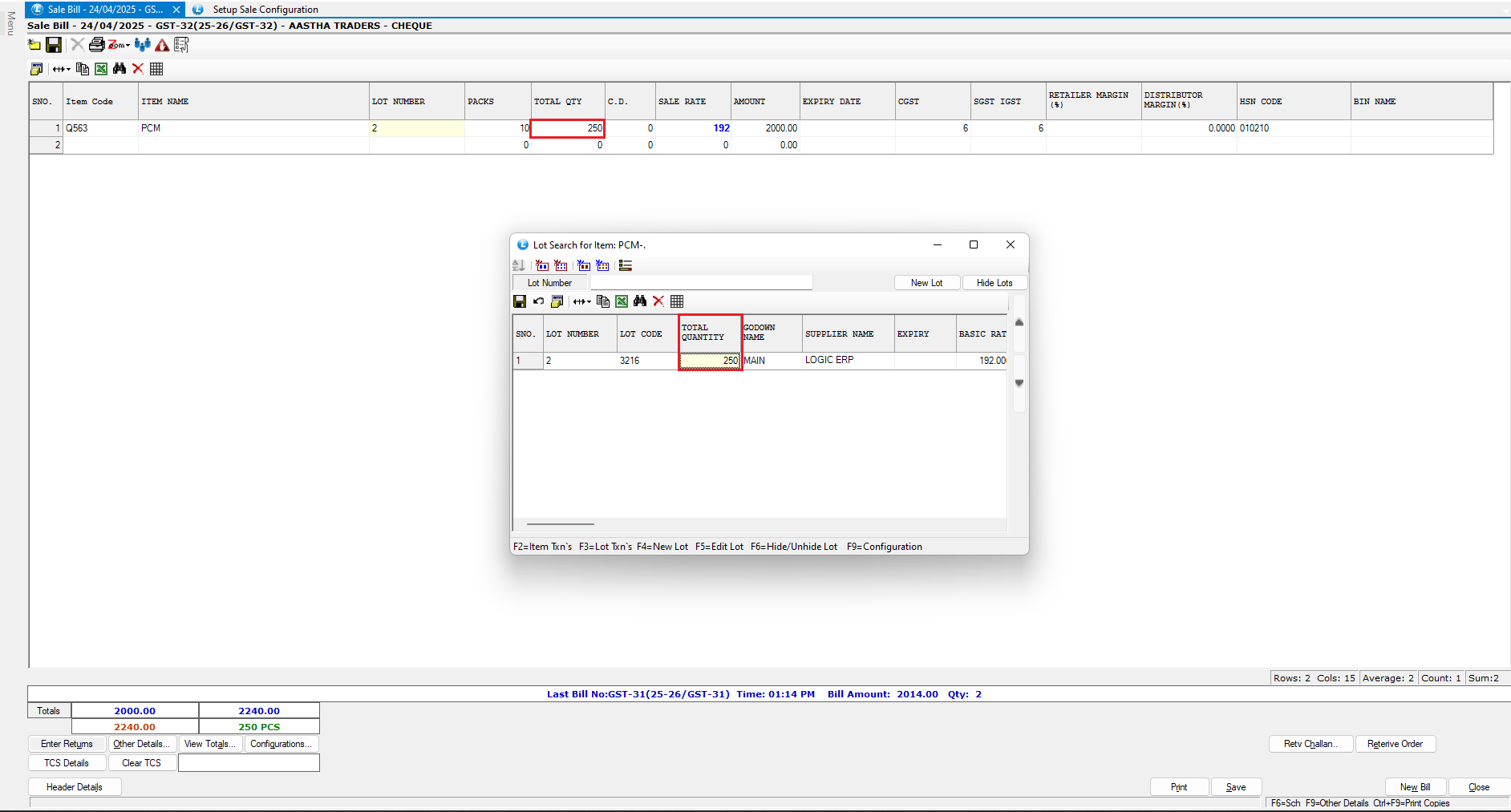
* **Current Stock**
  * Automatically sets the quantity to the **current available stock** of the item.

<figure><img src="https://4031188996-files.gitbook.io/~/files/v0/b/gitbook-x-prod.appspot.com/o/spaces%2FXMVkjt8zqHBQX1c9QvFS%2Fuploads%2FiD7cWqXe11npCEGa1d46%2FCurrent%20Stock.png?alt=media&#x26;token=9d9b45a9-4f42-4b12-b8ed-d8723c62c0f1" alt=""><figcaption><p>In this picture, the functionality of "<strong>Current Stock</strong>" has been illustrated.</p></figcaption></figure>

* Helpful for scenarios like stock clearance, inventory review, or sample billing.

***

#### **Conclusion**

This feature provides flexibility and automation in item quantity handling during billing, reducing manual input and ensuring consistency based on predefined item configurations.