> For the complete documentation index, see [llms.txt](https://kb.logicerp.com/llms.txt). Markdown versions of documentation pages are available by appending `.md` to page URLs; this page is available as [Markdown](https://kb.logicerp.com/logic-erp-learning-hub-tutorials-and-best-practices/user-access/logic-global-admin/others/common-settings/prompt-document-number-and-date-after-save-in-all-documents.md).

# Prompt Document Number and Date after Save in all documents

**YouTube:** [How to Enable Prompt for Document Number and Date After Saving All Documents?](https://www.youtube.com/watch?v=nQFlfX7RJvQ)

## How to Enable Prompt for Document Number and Date After Saving All Documents?

In this tutorial, we will explore a feature in **Logic ERP** that displays a **prompt showing the document number and date** immediately after saving any document. This helps users quickly confirm successful entry and track document references.

***

### **Enable the Setting in Logic Admin**

* Open the **Logic Admin Panel**.
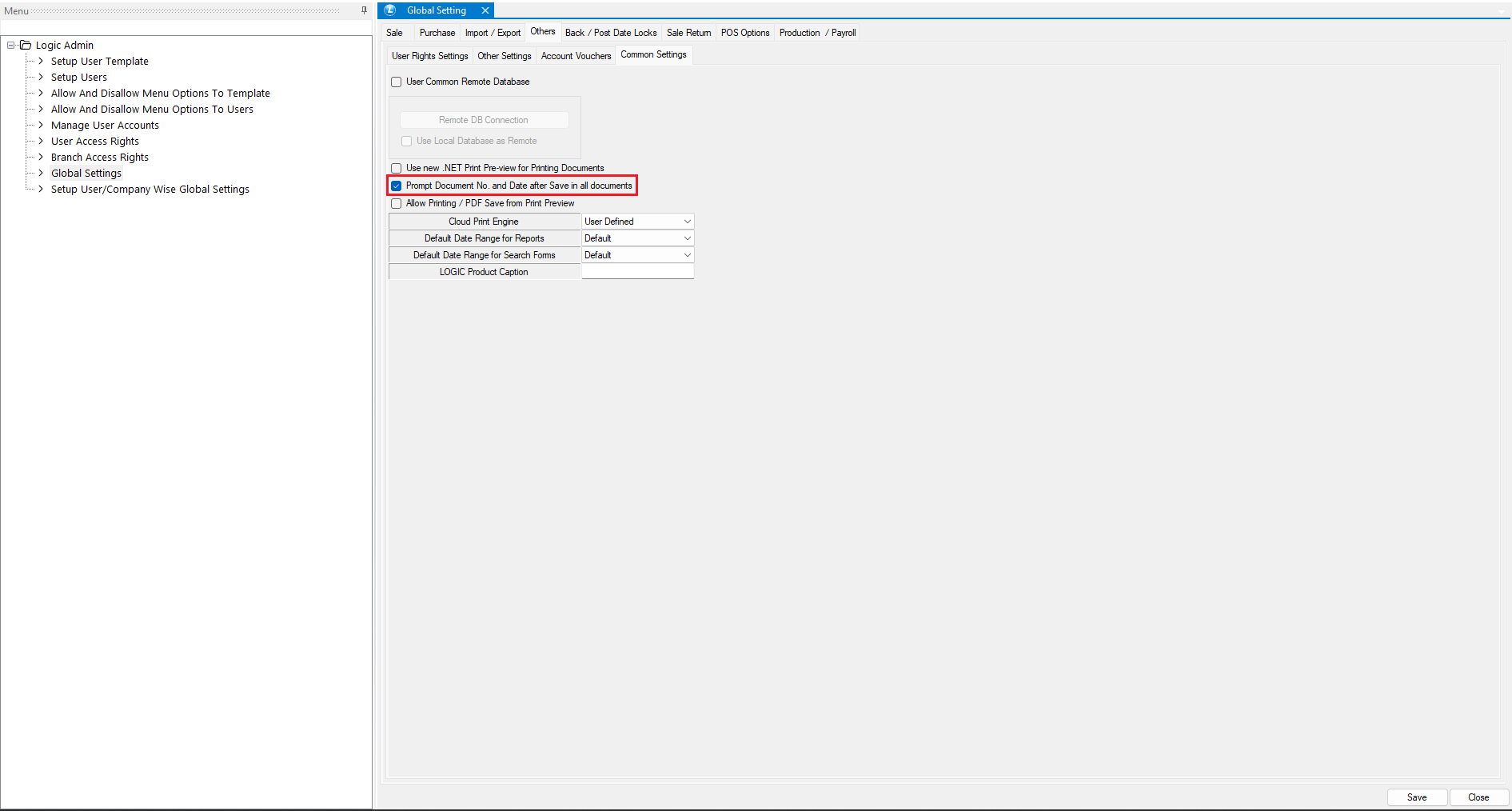
* Navigate to the "**Global Settings"** and then select **"Other".**
* Under the **"Common Settings"** Locate and enable the option labeled as:
* &#x20;**“Prompt document number and date after save in all documents”**

<figure><img src="https://4031188996-files.gitbook.io/~/files/v0/b/gitbook-x-prod.appspot.com/o/spaces%2FXMVkjt8zqHBQX1c9QvFS%2Fuploads%2FU8gNhGwwEAC8XzGW0rAb%2FAdmin%20Setup.png?alt=media&amp;token=e1c2cdf3-5213-4d26-a6ba-7d2272109871" alt=""><figcaption><p>Let's proceed with this option turned on to understand its practical implications in Voucher entry.</p></figcaption></figure>

* Click **Save** to apply the setting.
* **Restart Logic ERP** to activate the feature.

***

### **Verify the Feature**

* Open any module—for example, create a **Sale Bill**.
* After completing and **saving** the document:
  * A **prompt window** will automatically appear.
  * It will display the **Document Number** and **Date** of the saved entry.

<figure><img src="https://4031188996-files.gitbook.io/~/files/v0/b/gitbook-x-prod.appspot.com/o/spaces%2FXMVkjt8zqHBQX1c9QvFS%2Fuploads%2F0XF6hxWtbBz58bDS395u%2FSave%20Prompt.png?alt=media&amp;token=bda038d1-8dff-4d64-8893-aaa61366f166" alt=""><figcaption><p>As illustrated in the image, the software has triggered a prompt.</p></figcaption></figure>

***

### **Conclusion**

The **“Prompt document number and date after save”** feature enhances usability by giving immediate feedback after saving a document. It ensures that users can quickly note the reference number for future tracking or reporting.


---

# Agent Instructions
This documentation is published with GitBook. GitBook is the documentation platform designed so that both humans and AI agents can read, navigate, and reason over technical content effectively. Learn more at gitbook.com.

## Querying This Documentation
If you need additional information that is not directly available in this page, you can query the documentation by asking a question.

Perform an HTTP GET request on the following URL with the `ask` and `goal` query parameters:

```
GET https://kb.logicerp.com/logic-erp-learning-hub-tutorials-and-best-practices/user-access/logic-global-admin/others/common-settings/prompt-document-number-and-date-after-save-in-all-documents.md?ask=<question>&goal=<user_goal>
```

`ask` is the immediate question: it should be specific, self-contained, and written in natural language.
`goal` is what the user is ultimately trying to achieve, the reason they need the answer. Sharing it helps GitBook give you a better, more relevant answer. A goal is most helpful when it describes the outcome the user wants rather than restating the question. For example, with `ask=how do I create an API token`, a goal like `automate deployments from our CI pipeline` lets GitBook tailor the answer to that use case.

The response will contain a direct answer to the question and relevant excerpts and sources from the documentation.

Use this mechanism when the answer is not explicitly present in the current page, you need clarification or additional context, or you want to retrieve related documentation sections.
