> For the complete documentation index, see [llms.txt](https://kb.logicerp.com/llms.txt). Markdown versions of documentation pages are available by appending `.md` to page URLs; this page is available as [Markdown](https://kb.logicerp.com/logic-erp-version-release-notes/october-2021/accounts/new-options-in-setup-tds-types.md).
# New Options in Setup TDS Types
**YouTube:** [NEW OPTIONS ADDED IN SETUP TDS TYPES.](https://youtu.be/9ZY6Vndm-HQ)
Users can now define the amount on which TDS will be applied, as per their requirement. Apart from this, one TDS type can be linked with another.\
\
This tutorial will brief you about the **new columns** that have been added in **Setup TDS types** in Logic ERP.
**1.TDS under GST**
**Step-1**: Go to the **Setup TDS Type** window to create a new TDS Type as shown in the picture below. Fill all the details and define the amount after which TDS will be in effect.
A **new column of TDS Section ID** has been added. Select the appropriate section of TDS type from the **TDS Sections search list**. *(Refer to the image below):*
Another **new column of UD Net Amount** has been added. Define the amount on which you want the TDS to be applied in purchase bill.\
\
**For example,** if you want that the TDS should be applied on the amount after deducting CD, then you will have to tick the option of CD. *(Refer to the image below):*
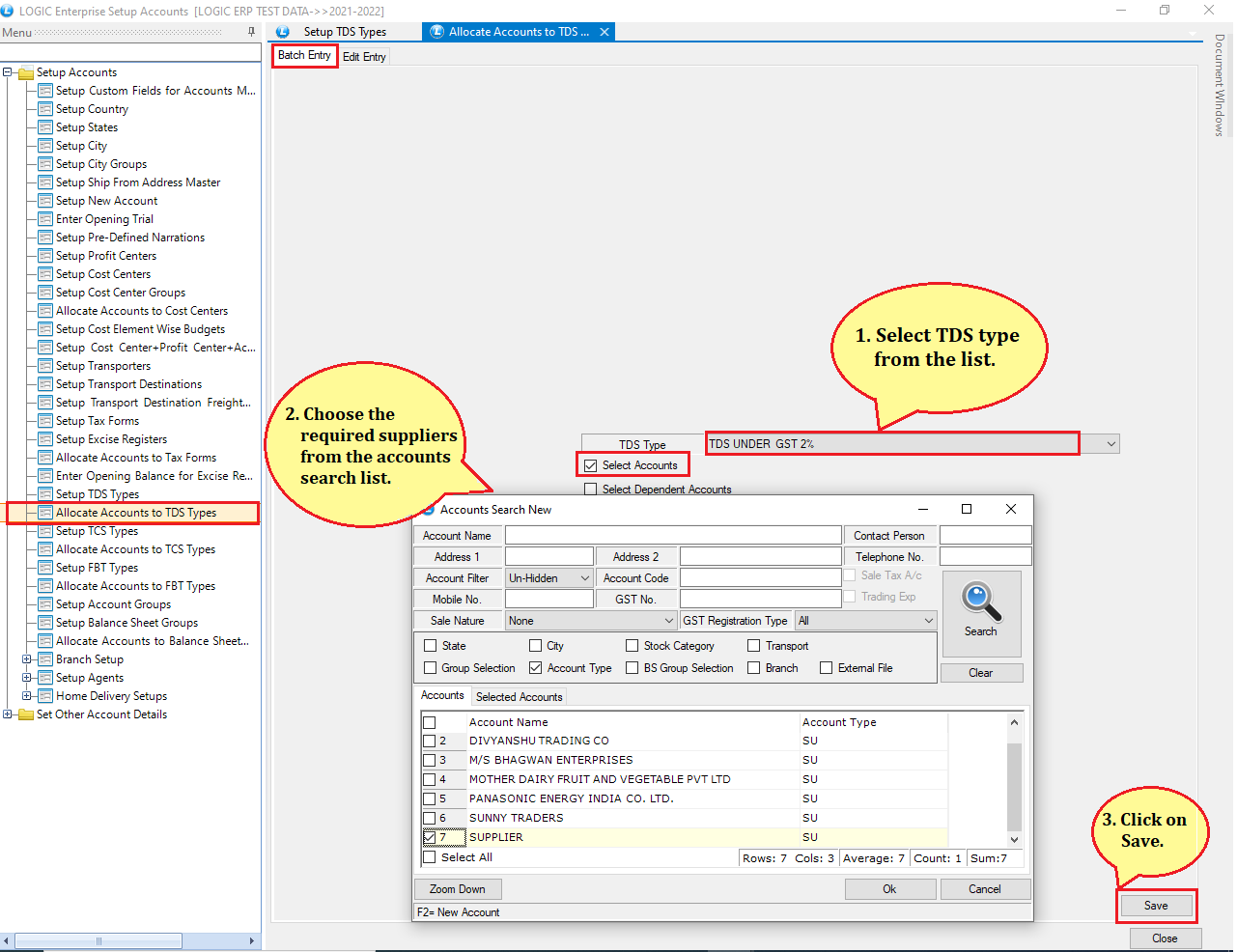
**Step-2**: Now go to **Allocate Accounts to TDS Types** window and select the TDS type from the list of TDS type. Then, click on select accounts to choose the required suppliers from the search window. *(Refer to the image below):*
**Step-3:** Go to **Purchase Voucher** and select the **Account name** which you had allocated to TDS under GST type in the previous step. Then click on **Item details** to generate the bill.\
\
In the bill shown below, CD\@5% has been entered in the item details. So, Taxable Amount is Rs.2,85,000 (Rs.3,00,000 – Rs.15,000) i.e. Gross Amount – C.D.
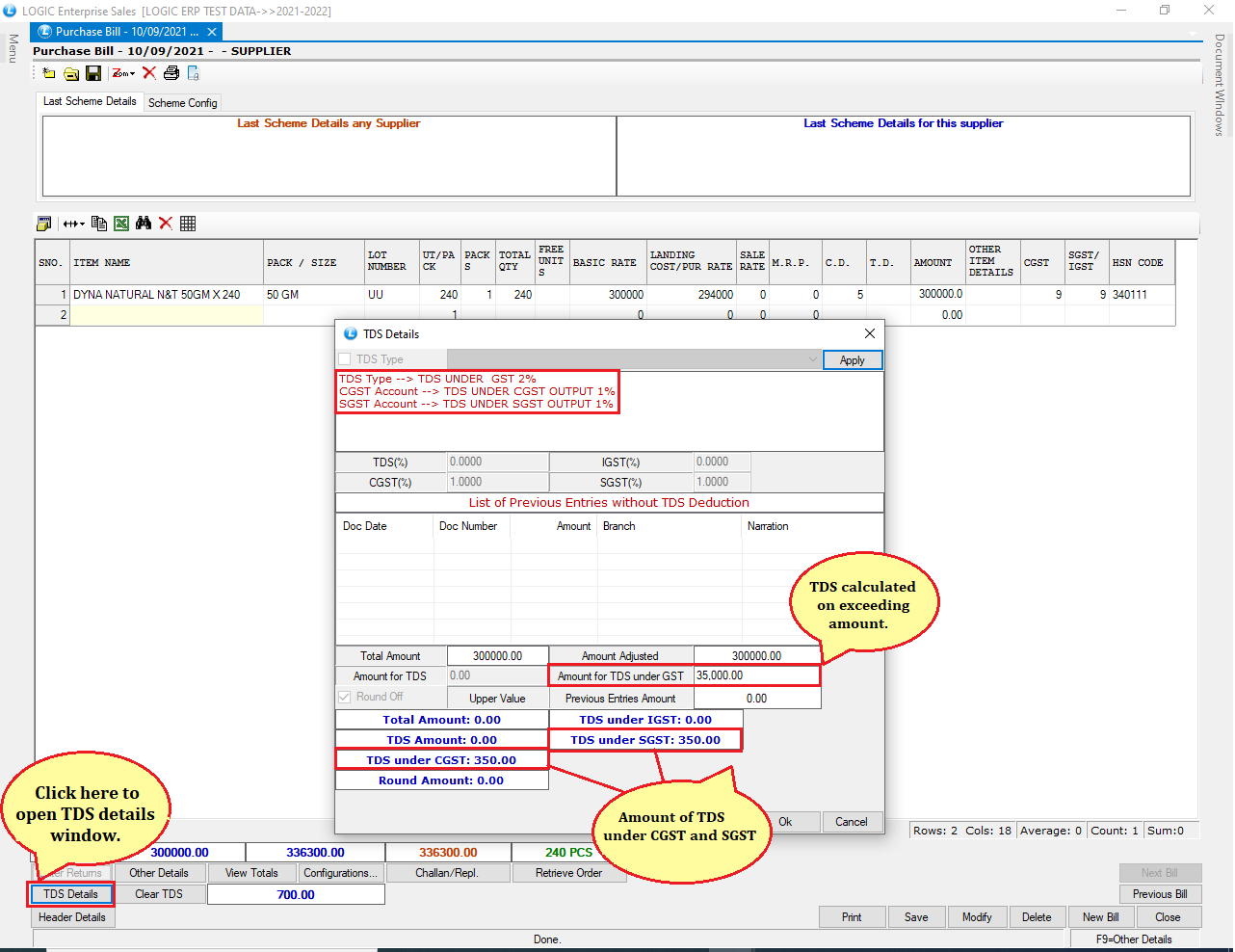
After filling items, click on the **TDS Details** button. You will see the TDS amount that is applied to the bill.\
\
***For example***, in this case, the Minimum Amount was defined as Rs.2,50,000 in the Setup TDS Type window. Now here, the billing amount exceeds Rs.2,50,000 i.e. Rs.2,85,000(Gross Amount – C.D.). So here, the TDS amount has been applied on Rs.35,000 that got accumulated in the bill after exceeding Rs.2,50,000 amount that was defined in the Setup TDS Type window.
**TDS under GST** will get displayed in the Journal report as shown in the picture below:
## **2. Normal TDS**
**Step-1:** Go to the **Setup TDS Type** window to create a new TDS Type as shown in the picture below and fill all the details.\
\
A **new column of TDS Section ID** has been added. Select the appropriate section of TDS type from the **TDS Sections search list** as already demonstrated in TDS under GST.\
\
Another **new column of Linked TDS Type** has been added. This column enables the users to link one TDS type with another. This option will be useful in cases where **two TDS types are to be applied on a single purchase bill.** *For example, in the image shown below, TDS under GST 2% has been linked with Normal TDS type.*
**Step-2**: Now go to **Allocate Accounts to TDS Types** window and select the TDS type from the list of TDS type. Then, click on select accounts to choose the required suppliers from the search window as already demonstrated in TDS under GST.
**Step-3:** Go to **Purchase Voucher** and select the **Account name** which you had allocated to Normal TDS type in Step-2. Then click on **Item details** to generate the bill.\
\
In the bill shown below, CD\@2% has been entered in the item details. So,\
Taxable Amount is Rs.2,94,000 (Rs.3,00,000 – Rs.6,000) i.e. Gross Amount – C.D.
After filling items, click on the **TDS Details** button. You will see the TDS amount that is applied to the bill.\
\
In the bill shown below, two **TDS types have been applied** because we have linked TDS under GST with Normal TDS in Setup TDS type window.\
\
–**Normal TDS** has been applied on Gross amount of Rs.3,00,000 at the rate of 10%. So, amount of Normal TDS is Rs.30,000.\
–**TDS under GST** has been applied on the amount exceeding the minimum limit of Rs.2,50,000 which is Rs.2,94,000(Gross Amount – C.D.). So, amount for TDS under GST is Rs.44,000.
**Normal TDS and TDS under GST** will get displayed in the Journal report as shown in the picture below:
## **3. TDS on Goods**
**Step-1:** Go to the **Setup TDS Type** window to create a new TDS Type as shown in the picture below. Fill all the details and define the amount after which TDS will be effective.\
\
Three new columns have been added in this TDS type.\
**1. TDS Section ID column** has been added. Select the appropriate section of TDS type from the **TDS Sections search list** as already demonstrated in TDS under GST.\
\
**2. Linked TDS Type column** has been added. This column enables the users to link one TDS type with another. This option will be useful in cases where **two TDS types are to be applied on a single purchase bill.** It has already been demonstrated in Normal TDS.\
\
**3. UD Net Amount column** has been added. Define the amount on which you want the TDS to be applied in purchase bill.\
**For example,** if you want that the TDS should be applied on the amount after deducting CD, then you will have to tick the option of CD. *(Refer to the image below):*
**Step-2**: Now go to **Allocate Accounts to TDS Types** window and select the TDS type from the list of TDS type. Then, click on select accounts to choose the required suppliers from the search window as already demonstrated in TDS under GST.
**Step-3:** Go to **Purchase Voucher** and select the **Account name** which you had allocated to TDS on Goods type in Step-2. Then click on **Item details** to generate the bill.\
\
In the bill shown below, CD\@2% has been entered in the item details. So, Taxable Amount is Rs.58,80,000 (Rs.60,00,000 – Rs.1,20,000) i.e. Gross Amount – C.D.
After filling items, click on the **TDS Details** button. You will see the TDS amount that is applied to the bill.\
\
In the bill shown below, two **TDS types have been applied** because we have linked TDS under GST with TDS on Goods in Setup TDS type window.\
\
–**TDS on Goods** has been applied on the amount exceeding the minimum limit of Rs.50,00,000 i.e. Rs.58,80,000 (Gross Amount – C.D.). So, amount for TDS on Goods is Rs.8,80,000.\
–**TDS under GST** has been applied on the amount exceeding the minimum limit of Rs.2,50,000 i.e. Rs.58,80,000 (Gross Amount – C.D.). So, amount for TDS under GST is Rs.56,30,000.
**TDS on Goods and TDS under GST** will get displayed in the Journal report as shown in the picture below:
---
# Agent Instructions
This documentation is published with GitBook. GitBook is the documentation platform designed so that both humans and AI agents can read, navigate, and reason over technical content effectively. Learn more at gitbook.com.
## Querying This Documentation
If you need additional information that is not directly available in this page, you can query the documentation by asking a question.
Perform an HTTP GET request on the following URL with the `ask` and `goal` query parameters:
```
GET https://kb.logicerp.com/logic-erp-version-release-notes/october-2021/accounts/new-options-in-setup-tds-types.md?ask=&goal=
```
`ask` is the immediate question: it should be specific, self-contained, and written in natural language.
`goal` is what the user is ultimately trying to achieve, the reason they need the answer. Sharing it helps GitBook give you a better, more relevant answer. A goal is most helpful when it describes the outcome the user wants rather than restating the question. For example, with `ask=how do I create an API token`, a goal like `automate deployments from our CI pipeline` lets GitBook tailor the answer to that use case.
The response will contain a direct answer to the question and relevant excerpts and sources from the documentation.
Use this mechanism when the answer is not explicitly present in the current page, you need clarification or additional context, or you want to retrieve related documentation sections.