# TDS Rounding

**YouTube:** [How to Configure Different TDS Rounding Methods in Purchase ?](https://www.youtube.com/watch?v=n76v5GKQp58)

## How to Configure Different TDS Rounding Methods in Purchase ?

 In this tutorial, we will explore the **TDS rounding options** available in **Purchase Configuration** under **Purchase Voucher Settings** in Logic ERP. The system provides multiple rounding parameters to adjust the **TDS amount**, ensuring accuracy in financial transactions.

### **Accessing TDS Rounding Options**

* Navigate to the **Purchase Voucher Configuration.**&#x20;
* Under the **Other Settings** 3
* **TDS Rounding Option** (Dropdown Menu).
* By default, the system is set to **Upper Value Rounding**.

<figure><img src="/files/g5YziV11oFiigKZs3dkv" alt=""><figcaption><p>As mentioned above, follow the given steps and select the appropriate option from the dropdown as per your requirement.</p></figcaption></figure>

### **Understanding Different Rounding Parameters**

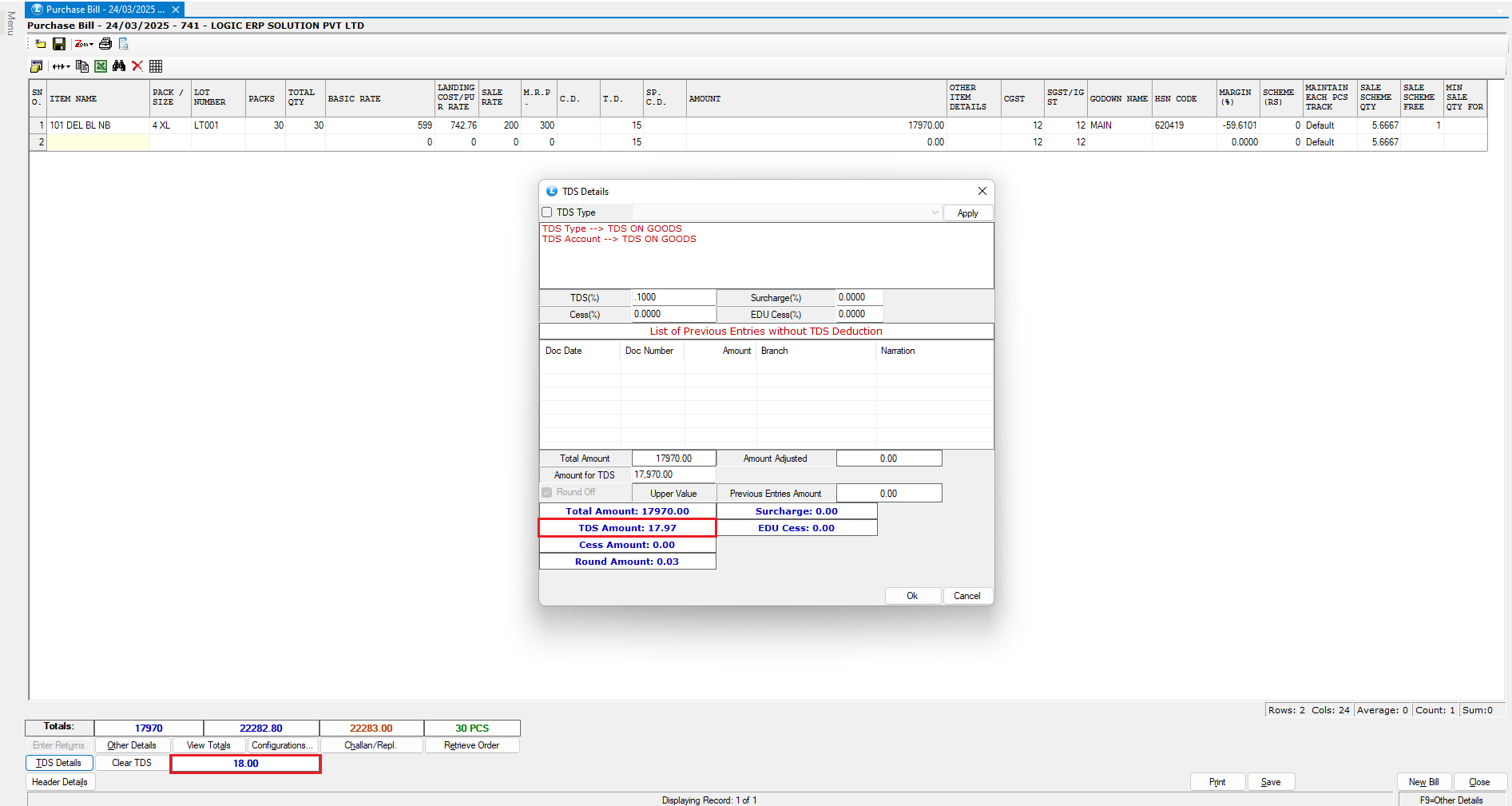
* **Upper Value Rounding (Default)**
  * The TDS amount is rounded **upward** to the nearest whole number.
  * Example: **₹17.97** → Rounded to **₹18**

<figure><img src="/files/j403KeGBWvrp0RDu53ED" alt=""><figcaption><p>As you can see, the software has rounded off the value of 17.97 to the upper value of ₹18.</p></figcaption></figure>

* **Nearest ₹1 Rounding**
  * The TDS amount is rounded to the **nearest whole rupee**.
  * Example: **₹13.59** → Rounded to **₹14**
* **Nearest ₹0.50 Paise Rounding**
  * The TDS amount is rounded to the **nearest 0.50 paise**.
  * Example: **₹22.28** → Rounded to **₹22**

<figure><img src="/files/3BNVqG3GujNzofmEcR6w" alt=""><figcaption><p>As you can see, the software has rounded off the value of 22.28 to ₹22 as per the nearest 0.50 rounding rule.</p></figcaption></figure>

* **Nearest ₹5 Rounding**
  * The TDS amount is rounded to the **nearest multiple of ₹5**.
  * Example: **₹23.49** → Rounded to **₹25**

<figure><img src="/files/TRO9KsL3ryCA2E7MN1AX" alt=""><figcaption><p>As you can see, the software has rounded off ₹23.49 to ₹25 as per the <em>Nearest ₹5</em> rounding rule.</p></figcaption></figure>

* **Nearest ₹10 Rounding**
  * The TDS amount is rounded to the **nearest multiple of ₹10**.
  * Example: **₹23.49** → Rounded to **₹20**

<figure><img src="/files/grPTUx8JoLbbJ9IqFjI4" alt=""><figcaption><p>As you can see, the software has rounded ₹23.49 to ₹20 as per the <strong>Nearest ₹10 Rounding</strong> setting.</p></figcaption></figure>

* **Lower Value Rounding**
  * The TDS amount is rounded **downward** to the nearest whole number.
  * Example: **₹23.48** → Rounded to **₹23**

<figure><img src="/files/tHMkYFRi2ZDa7xnq5M3V" alt=""><figcaption><p>As you can see, the software has rounded off ₹23.48 to ₹23 as per the Lower Value Rounding setting.</p></figcaption></figure>

### **Conclusion**

TDS rounding options in **Logic ERP** help businesses manage tax deductions efficiently by selecting the appropriate rounding method as per financial policies.


---

# Agent Instructions: Querying This Documentation

If you need additional information that is not directly available in this page, you can query the documentation dynamically by asking a question.

Perform an HTTP GET request on the current page URL with the `ask` query parameter:

```
GET https://kb.logicerp.com/logic-erp-learning-hub-tutorials-and-best-practices/setups/configurations/purchase-voucher-configurations/other-settings-3/tds-rounding.md?ask=<question>
```

The question should be specific, self-contained, and written in natural language.
The response will contain a direct answer to the question and relevant excerpts and sources from the documentation.

Use this mechanism when the answer is not explicitly present in the current page, you need clarification or additional context, or you want to retrieve related documentation sections.