> For the complete documentation index, see [llms.txt](https://kb.logicerp.com/llms.txt). Markdown versions of documentation pages are available by appending `.md` to page URLs; this page is available as [Markdown](https://kb.logicerp.com/logic-erp-learning-hub-tutorials-and-best-practices/setups/setup-items/setup-item-group.md).

# Setup Item Group

**YouTube:** [How to create Item Groups in Logic ERP?](https://www.youtube.com/watch?v=JZBMVtBzhfQ\&t=1s)

## How to create Item Groups in Logic ERP?

In this Tutorial, you will learn how to efficiently **set up item groups** in **Logic ERP** to streamline inventory management.

### **Step-By-Step Guide:**

1. Navigate to the "Setup" and then Expand "Setup Items".
2. Click on "Setup Item Groups".
3. You can create **up to 30 group categories** for organizing items.

<figure><img src="/files/P138z1uqzxgx1c5QFCJT" alt=""><figcaption><p>As you can see, <strong>30 Groups</strong> are being shown here.</p></figcaption></figure>

### **Understanding GST Tax Groups**

* The **GST tax group category** is **predefined** in the system.
* It includes **five slabs of GST percentages**, and items are **allocated accordingly**.

<figure><img src="/files/z6jZXLjwtNIKXBw8Nuyd" alt=""><figcaption><p>This picture shows how GST groups can be created.</p></figcaption></figure>

### **Creating Item Groups**

* Each group contains **five levels**.
* **Right-click** on a group to **rename** it and enter the desired name.
* You can also **rename each level** as needed.
* Click **Refresh** to apply changes.

<figure><img src="/files/b5iR5gBeEopEeVVSdjs8" alt=""><figcaption><p>This picture shows how to create a new group.</p></figcaption></figure>

### **Defining Item Group Details**

* **Enter the group name** and a **short name**.
* Select whether the item is **raw material or finished product**.
* **Define the margin percentage**—this automatically calculates **MRP** by adding the defined percentage to the **basic rate**.
* Press **Spacebar** to enable a prompt message during **sale billing** (useful for pharmaceutical businesses with **prescription-based medicines**).
* **Add descriptions** (up to **seven descriptions**) for better classification.
* Click **Save** to store the changes.

<figure><img src="/files/5bc1qw3Ld65ML7lvqK2s" alt=""><figcaption><p>This picture shows how to define the details of a group.</p></figcaption></figure>

### **Allocating Items to Groups**

* Right-click on the group and select **"Allocate."**.
* Search and select the items to allocate.
* **Note:** An item **cannot belong to multiple groups**.
* To remove an item from a group, click **Deallocate**.

<figure><img src="/files/AwWTVsIlM9QueJAuUZbn" alt=""><figcaption><p>This picture shows how to allocate a group.</p></figcaption></figure>

### **Creating Multi-Level Grouping**

* Create **Level 2 groups** the same way as Level 1.
* Allocate **Level 1 groups** into **Level 2**.
* Similarly, **Level 2** groups can be allocated into **Level 3**, creating a **hierarchical structure** up to **five levels**.

### **Managing Group Order & Moving Groups**

* Click **Refresh** and click on **Order** to **rearrange groups** using arrows.
* The **Move Item Groups** feature allows **copying** categories to another group.
* Items can also be moved between groups.

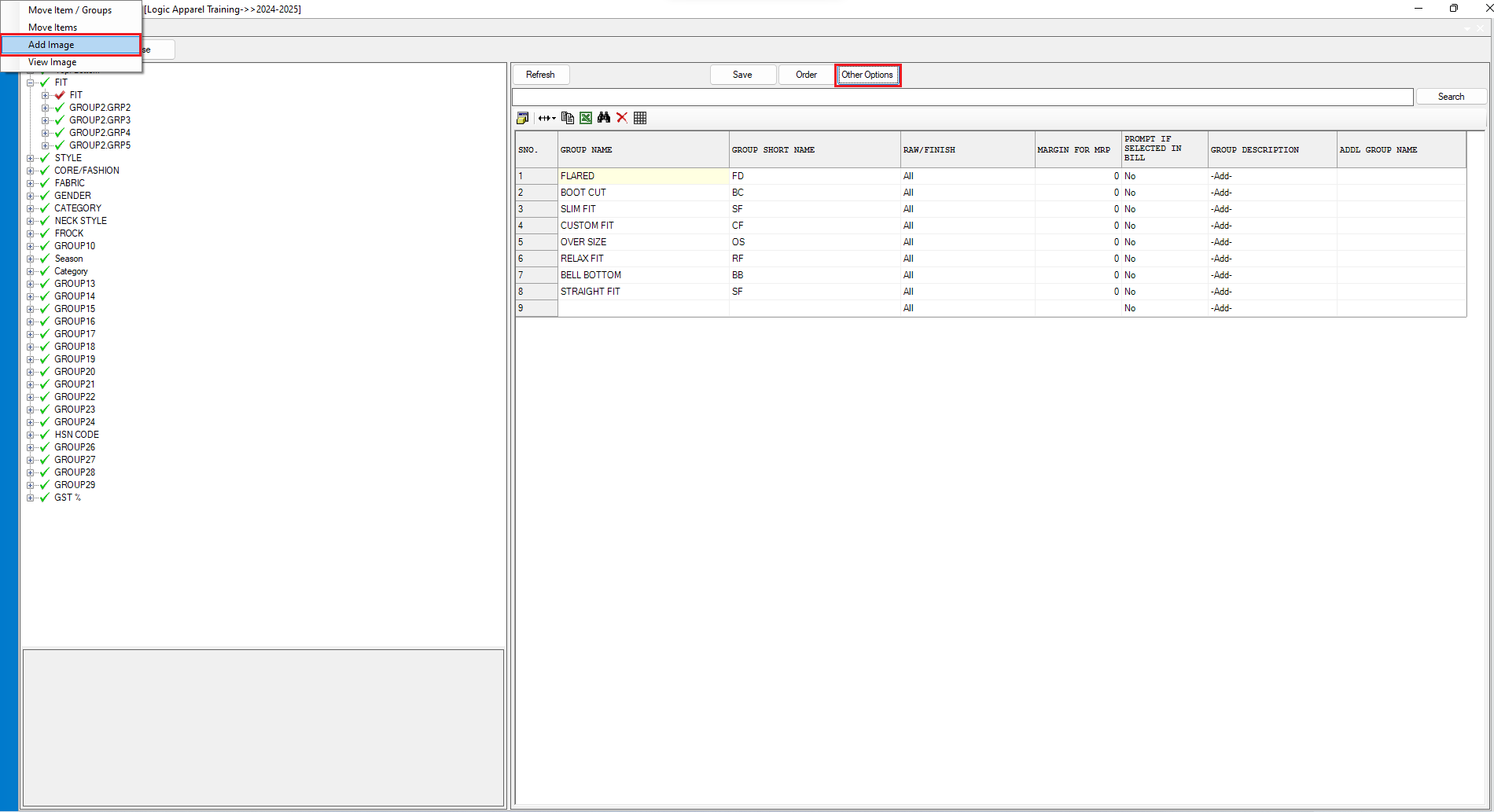
### **Adding Images to Groups**

* Browse and upload an **image** for each group.
* The image will be **visible during billing**, helping in quick identification.

<figure><img src="/files/qW8h8mawTfnY1efnWn4q" alt=""><figcaption><p>This picture shows how to add an image to a group.</p></figcaption></figure>

### **Practical Applications in Different Businesses**

#### **Pharmaceutical Business**

* Group items based on **Schedule H, Schedule H1, and NRX categories**.
* Enable prompt alerts for **Schedule H1** items during billing.
* Items can also be grouped based on **salt names**.

<figure><img src="/files/jH4J4gZW4kVC1gPQLNc8" alt=""><figcaption><p>This picture illustrates how to create pharma groups and enable the prompt.</p></figcaption></figure>

#### **Apparel Business**

* Apparel grouping is highly **customizable**.
* Common grouping criteria include:
  * **Gender** (Men, Women, Kids)
  * **Season** (Summer, Winter, All-Season)
  * **Style** (Casual, Formal, Sportswear)
  * **Fit** (Slim, Regular, Relaxed)
  * **Occasion** (Party, Office, Daily Wear)

This structured **item grouping system** in **Logic ERP** ensures **better inventory organization**, simplifies billing, and improves operational efficiency.<br>


---

# Agent Instructions
This documentation is published with GitBook. GitBook is the documentation platform designed so that both humans and AI agents can read, navigate, and reason over technical content effectively. Learn more at gitbook.com.

## Querying This Documentation
If you need additional information that is not directly available in this page, you can query the documentation dynamically by asking a question.

Perform an HTTP GET request on the current page URL with the `ask` query parameter, and the optional `goal` query parameter:

```
GET https://kb.logicerp.com/logic-erp-learning-hub-tutorials-and-best-practices/setups/setup-items/setup-item-group.md?ask=<question>&goal=<endgoal>
```

`ask` is the immediate question: it should be specific, self-contained, and written in natural language.
`goal` is optional and describes the broader end goal you are ultimately trying to accomplish on behalf of the user. GitBook uses it to tailor the answer towards what is most useful for that goal.

The response will contain a direct answer to the question and relevant excerpts and sources from the documentation.

Use this mechanism when the answer is not explicitly present in the current page, you need clarification or additional context, or you want to retrieve related documentation sections.