> For the complete documentation index, see [llms.txt](https://kb.logicerp.com/llms.txt). Markdown versions of documentation pages are available by appending `.md` to page URLs; this page is available as [Markdown](https://kb.logicerp.com/logic-erp-installation-configuration-and-troubleshooting-solutions/faqs/scheme/implement-additional-discount-after-all-schemes-in-sale-bill.md).
# Implement Additional Discount after all Schemes in Sale Bill
**YouTube:** [How to apply an Additional Discount after all Schemes in Sale Bill?](https://youtu.be/7mcJY6EDIr8)
## How to Apply an Additional Discount after all Schemes in Sale Bill?
This tutorial explains how to configure an *additional discount scheme* in Logic ERP. This scheme is applied **after all standard schemes**, based on predefined conditions.
***
### **Create the Primary Scheme**
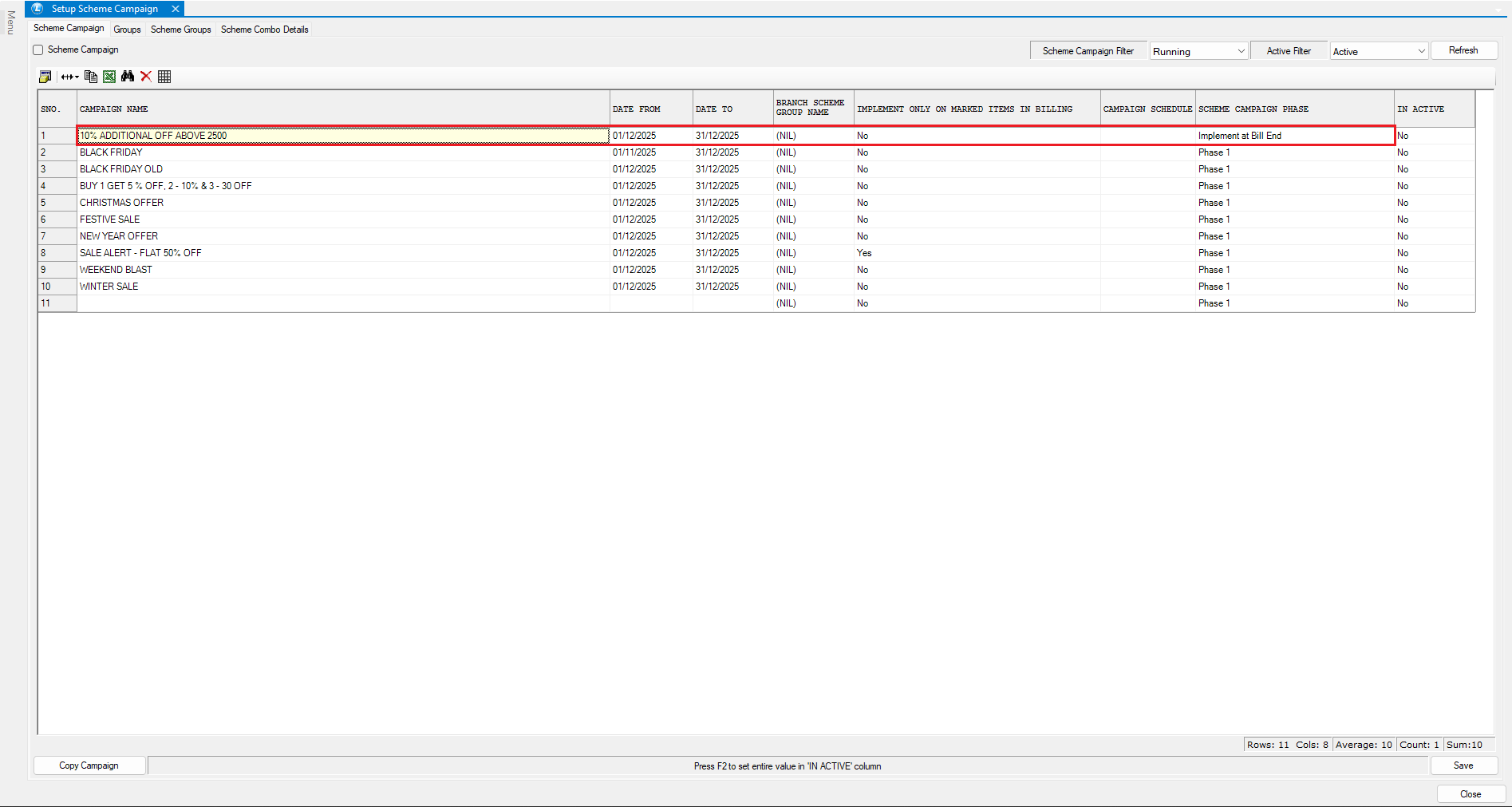
* Navigate to **Configuration Menu → Setup Scheme Campaign**.
* Click **Refresh**.
* Enter the **Scheme Campaign Name**.
* Define the **Active Period**.
* In the **Scheme Campaign Phase** column, press the **Space** key—**Phase 1** will be selected automatically.
* Click **Save**.
***
### **Create the Additional Discount Scheme**
* Create a **second scheme** for the additional discount.
* Set its **Active Period**.
* In the **Scheme Campaign Phase** column, select **Implement in the Bill End**.
* This ensures the discount applies **after all other schemes**.
* Click **Save**.
***
### **Configure Group Options**
* Go to the **Group Options** tab.
* Select the scheme campaign for Primary Scheme.
* Add a **Group Name**.
* In the **Scheme Group Type** column, press **Space** and select the appropriate group type.
* Save the settings.
> Repeat the same steps for the **Additional Scheme**.
* Select the scheme campaign for Additional Scheme.
* Add a **Group Name**.
* In the **Scheme Group Type** column, press **Space** and select the appropriate group type.
***
### **Define Scheme Group Details**
* Open the **Scheme Group** tab.
* Select the **Item Category/Brand** on which the scheme will apply for Primary Scheme.
* Save the details.
> Perform this configuration for Additional Scheme.
***
### **Configure Slab Details**
#### **For Primary Scheme**
* Navigate to **Scheme Campaign Slab Details**.
* Select the **Scheme Campaign**.
* Minimum Quantity: **1**
* Scheme Basis: **Quantity**
* Slab Value: **1**
* CD: **15%**
* Save the configuration.
#### **For Additional Discount Scheme**
* Select the **Additional Discount Scheme**.
* Minimum Value: **₹2,500**
* Scheme Basis: **Value**
* Slab Value: **₹2,500**
* TD: **10%**
* Save the configuration.
***
### **Implement the Scheme in Sale Bill**
* Open a **New Sale Bill**.
* Add an item belonging to the category configured under the **primary scheme**.
* Save the bill → The **15% discount** will be applied automatically.
* Add additional items to exceed a **bill value of ₹2,500**.
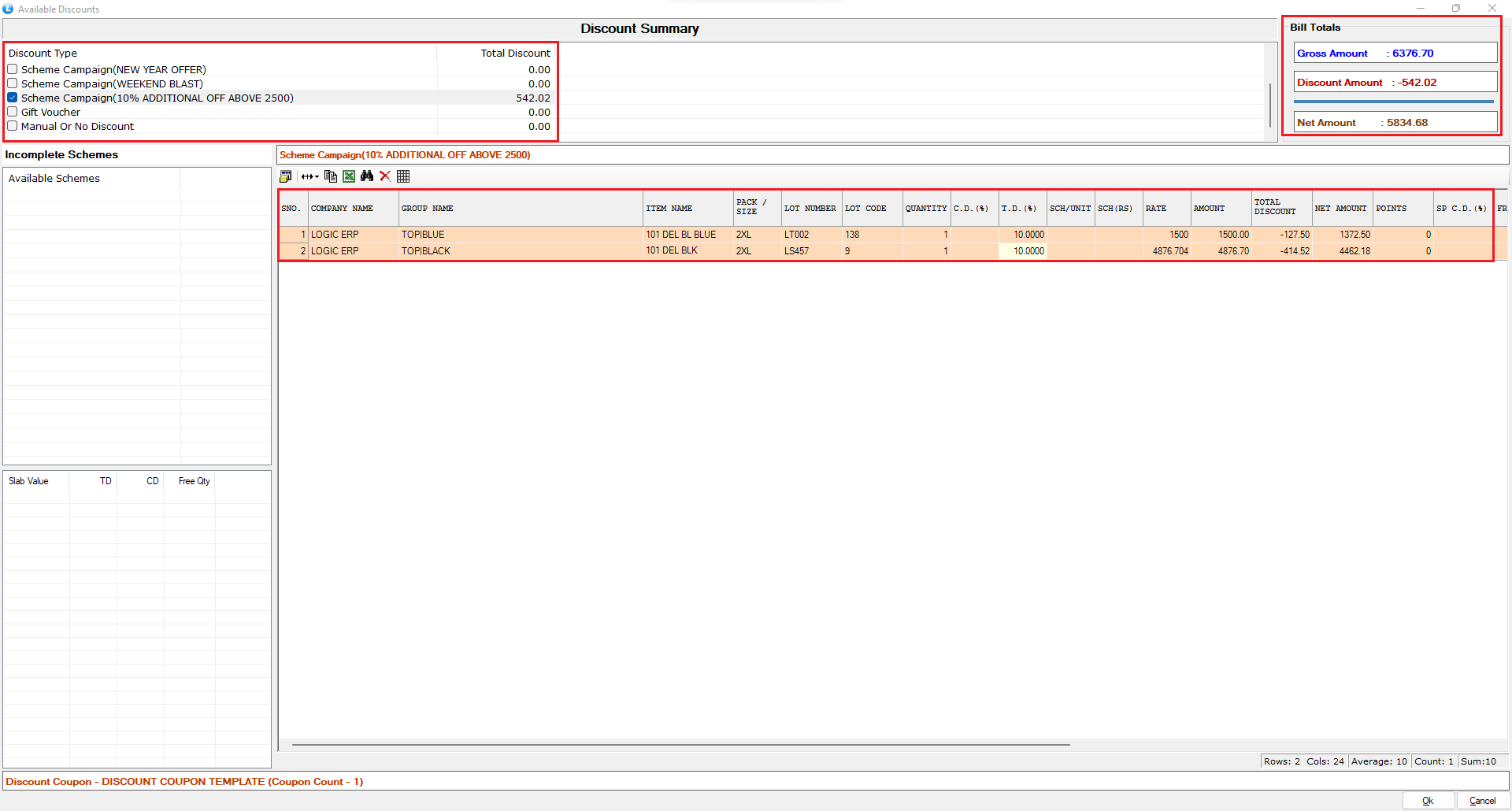
* Save the bill again → The **additional 10% discount** will be applied at **bill end**.
* As you can see at the end, both discounts have now been successfully applied in the Sale Bill.
***
### **Conclusion**
By following these steps, you can configure a dual-level discount system in Logic ERP. The first scheme applies during the bill, while the additional discount scheme is automatically applied at the bill end when the bill value meets the specified criteria. This ensures a flexible, layered discount structure that enhances customer benefits and improves billing efficiency.
---
# Agent Instructions
This documentation is published with GitBook. GitBook is the documentation platform designed so that both humans and AI agents can read, navigate, and reason over technical content effectively. Learn more at gitbook.com.
## Querying This Documentation
If you need additional information that is not directly available in this page, you can query the documentation dynamically by asking a question.
Perform an HTTP GET request on the current page URL with the `ask` query parameter, and the optional `goal` query parameter:
```
GET https://kb.logicerp.com/logic-erp-installation-configuration-and-troubleshooting-solutions/faqs/scheme/implement-additional-discount-after-all-schemes-in-sale-bill.md?ask=&goal=
```
`ask` is the immediate question: it should be specific, self-contained, and written in natural language.
`goal` is optional and describes the broader end goal you are ultimately trying to accomplish on behalf of the user. GitBook uses it to tailor the answer towards what is most useful for that goal.
The response will contain a direct answer to the question and relevant excerpts and sources from the documentation.
Use this mechanism when the answer is not explicitly present in the current page, you need clarification or additional context, or you want to retrieve related documentation sections.