> For the complete documentation index, see [llms.txt](https://kb.logicerp.com/llms.txt). Markdown versions of documentation pages are available by appending `.md` to page URLs; this page is available as [Markdown](https://kb.logicerp.com/logic-erp-learning-hub-tutorials-and-best-practices/user-access/set-user-wise-back-date-entry-modification-locking.md).
# Set User Wise Back Date Entry/Modification Locking
**YouTube:** [How to Configure User Wise Backdate Entry and Modification Locking Schedule?](https://www.youtube.com/watch?v=9tzO6QzIOEk)
## How to Configure User Wise Backdate Entry and Modification Locking Schedule?
In this tutorial, you will learn how to **configure user-specific restrictions** for **backdated entries and document modifications** in Logic ERP. This feature ensures **better control, accountability, and data security** for each user.
***
### Open User-Wise Locking Setup
**To Begin:**
* Navigate to the **User Access Module**.
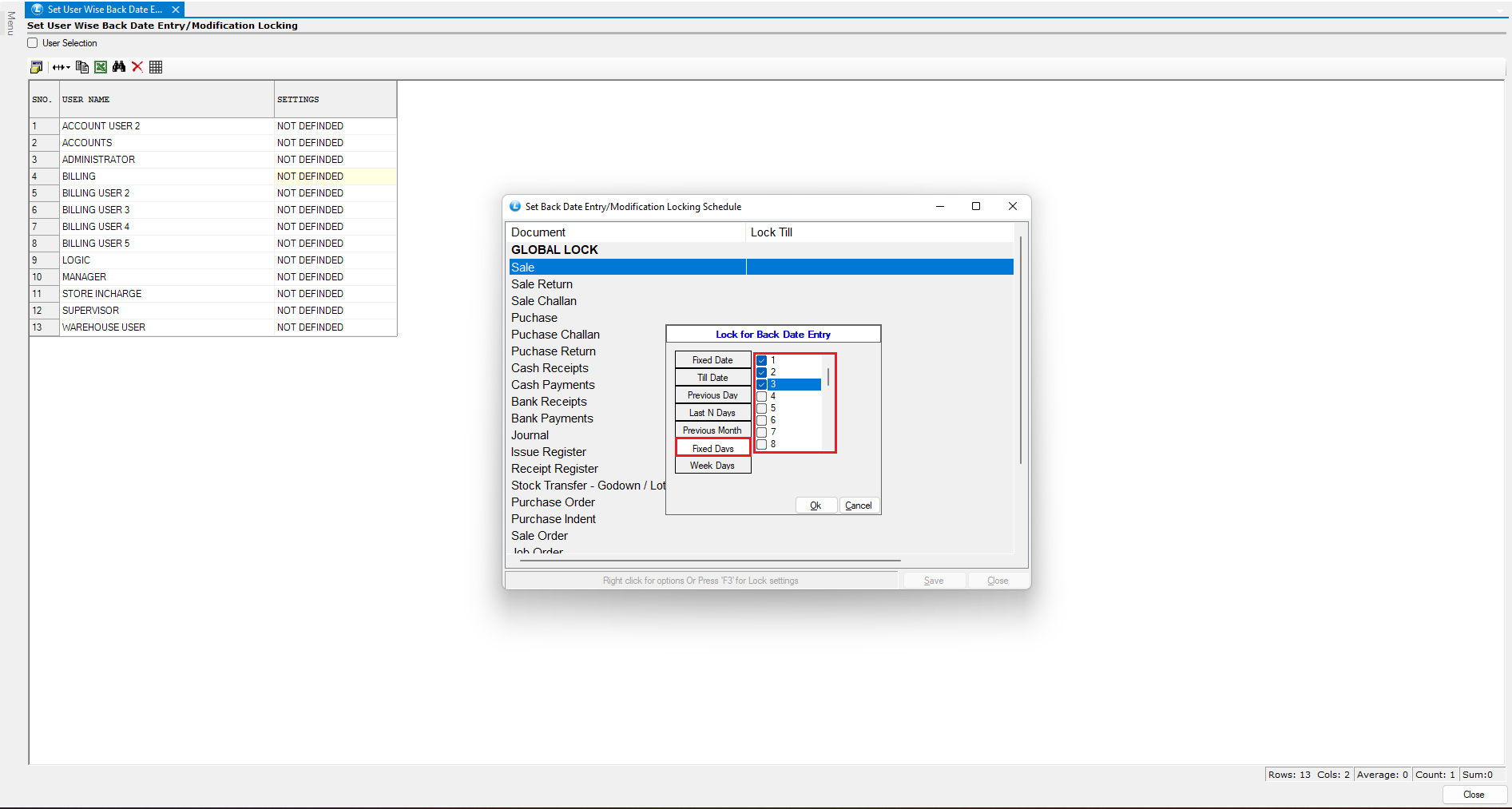
* Open **Set User Wise Back Date Entry / Modification Locking**.
This window displays:
* List of **Users**
* Their current **Setting Status**
* By default, the status appears as **“Not Defined”**, meaning no restrictions are applied.
***
### Select User for Configuration
Now define restrictions for a specific user.
* Locate the user (e.g., **Billing User 1**).
* Press the **Spacebar** in the **Setting Column**.
* This opens the **Backdate Entry / Modification Locking Schedule Window**.
***
### Choose Document for Locking
* A list of Documents will appear (e.g., Sale, Purchase, etc.).
* Select the **Sale Document**.
**Open Settings:**
* Right-click → Click **Settings**
* Or Press **F3** (shortcut)
***
### Configure Lock Criteria
* The **Lock for Back Date Entry Window** will open.
* Here, you can define various locking rules based on your requirements.
**Apply Fixed Days Lock**
* Let’s configure a **Fixed Days Lock**:
* Enter the number of days (e.g., **1, 2, 3 days**).
* Click **Save**.
**What this means:**
* The selected user:
* Cannot **modify existing bills** within these days
* Cannot **create backdated entries** for these days
***
### Log In with the User
* Log out of the system.
* Log in again using the **same user** for whom the lock is applied.
### Implement with Modification Restriction
* Navifgate to the **Sale Bill Window**.
* Open a bill within the **locked period**.
* Attempt to **modify and save** it.
**Result:**
* The system will **block the modification**
* An error message will appear:
* *Entry modification is locked for this period*
## Implement with Backdated Entry Restriction
* Create a **new sale bill**.
* Enter a **date within the locked period**.
* Try to **save the bill**.
**Result:**
* The system will **not allow saving**
* Backdated entries are **restricted for that user**
***
## Key Benefits of User-Wise Locking
* Apply restrictions to specific users
* Improve accountability and control
* Prevent unauthorized backdated entries
* Ensure data accuracy and audit compliance
* Customize access based on user roles
***
### Final Outcome
You have successfully learned how to:
* Configure **User-Wise Backdate Locking**
* Restrict **Modifications & Backdated Entries**
* Strengthen **data security and operational control**
Your system is now more **secure, controlled, and audit-ready**.
---
# Agent Instructions
This documentation is published with GitBook. GitBook is the documentation platform designed so that both humans and AI agents can read, navigate, and reason over technical content effectively. Learn more at gitbook.com.
## Querying This Documentation
If you need additional information that is not directly available in this page, you can query the documentation dynamically by asking a question.
Perform an HTTP GET request on the current page URL with the `ask` query parameter, and the optional `goal` query parameter:
```
GET https://kb.logicerp.com/logic-erp-learning-hub-tutorials-and-best-practices/user-access/set-user-wise-back-date-entry-modification-locking.md?ask=&goal=
```
`ask` is the immediate question: it should be specific, self-contained, and written in natural language.
`goal` is optional and describes the broader end goal you are ultimately trying to accomplish on behalf of the user. GitBook uses it to tailor the answer towards what is most useful for that goal.
The response will contain a direct answer to the question and relevant excerpts and sources from the documentation.
Use this mechanism when the answer is not explicitly present in the current page, you need clarification or additional context, or you want to retrieve related documentation sections.