> For the complete documentation index, see [llms.txt](https://kb.logicerp.com/llms.txt). Markdown versions of documentation pages are available by appending `.md` to page URLs; this page is available as [Markdown](https://kb.logicerp.com/logic-erp-installation-configuration-and-troubleshooting-solutions/faqs/sales/mark-item-as-a-sample-in-sale-bill.md).
# Mark Item as a Sample in Sale Bill
**YouTube:** [How to Mark an Item as a Sample in Sale Bill?](https://www.youtube.com/watch?v=PX3LU7Tr5EM)
## How to Mark an Item as a Sample in Sale Bill?
In this tutorial, we’ll show you **two methods** to mark an item as a **sample** while billing in Logic ERP.
***
### Method 1: Mark as Sample Using Zero Rate
This method is used when the company issues **free promotional or sample stock** and does **not want to record any monetary value**.
* Open the **Sales Bill** window in Logic ERP.
* Select the customer and item as you would for a regular transaction.
* In the **Rate** field of the item, enter **0**.
* A dropdown list will appear with options such as:
* **Free Replacement**
* **Sample**
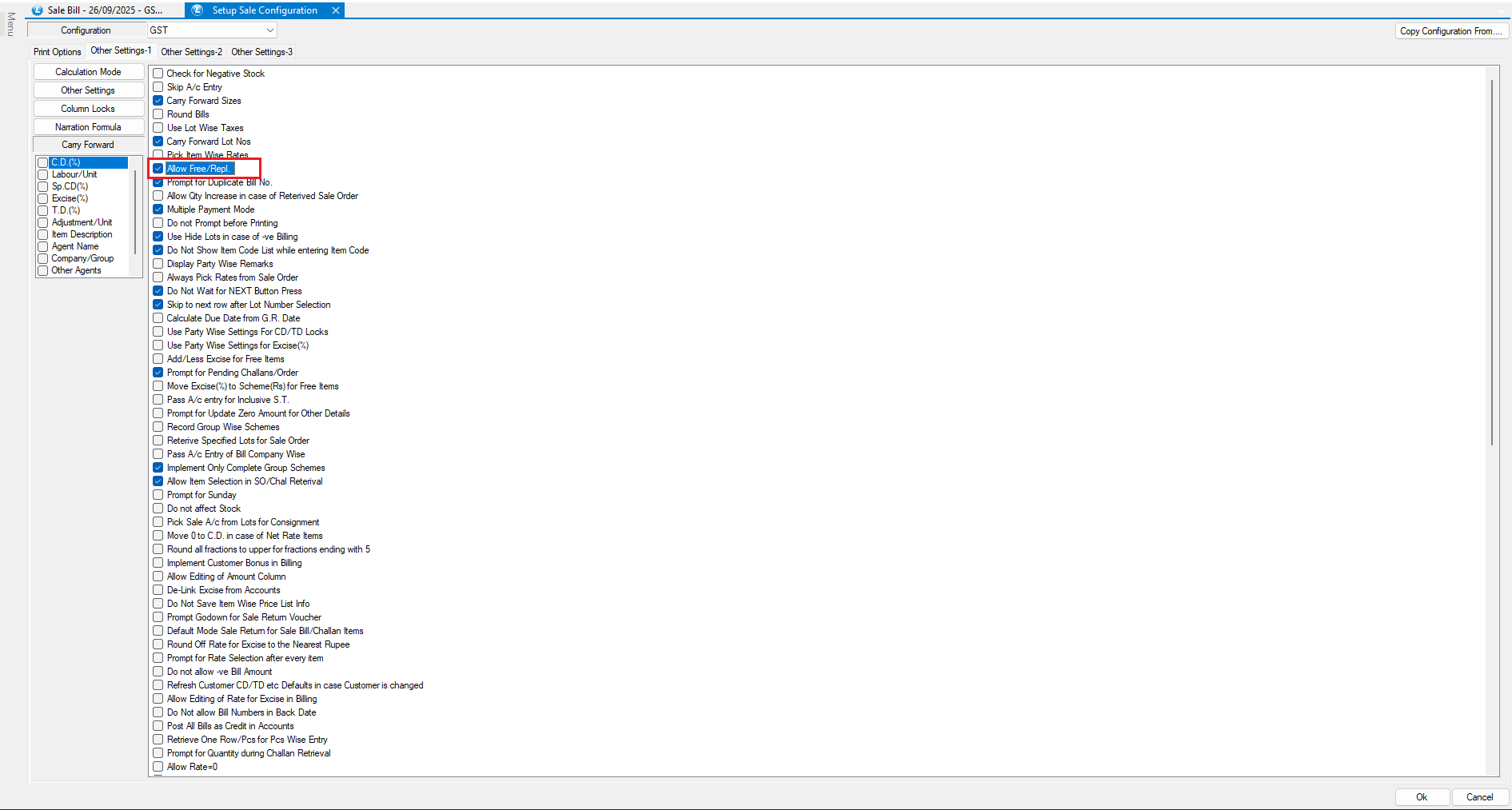
* To use this option, make sure the **Allow Free Replacement** setting is enabled in the **Sale Voucher Configuration** for the relevant billing series.
* Select **Sample** from the dropdown and proceed with the transaction.
In this method:
* The ERP records **only the quantity movement** of the item.
* No financial entry is created for the sample.
***
### Method 2: Mark as Sample Using F3 in Rate Column
This method is used when the company wants to track **both the stock movement and the monetary value** of the sample for reporting or analysis purposes.
* In the sales bill, transact the desired item as usual.
* In the **Rate** column, press **F3**.
* The item’s row will be **flagged in red**, indicating it is marked as a **sample**.
In this method:
* The ERP records the **issued quantity**.
* The system **calculates the monetary value** and adjusts it in the **Scheme Unit field**.
* This retains the value reference for **accurate reporting and analysis**.
***
### Review in Sales Report
After saving the bill, open the **Sales Report** to review the entries:
* **First Entry (Method 1)**:
* Shows **only stock movement**.
* No financial entry is recorded for the sample.
* **Second Entry (Method 2)**:
* Shows **both stock movement and monetary value**.
* Useful for **marketing cost evaluation, MRP validation, and sales comparisons**.
***
### Key Takeaways
* **Method 1 (Zero Rate)**: Tracks only stock movement; ideal for **free promotional distribution**.
* **Method 2 (F3 in Rate Column)**: Tracks both stock and monetary value; ideal for **reporting and analysis** needs.
---
# Agent Instructions
This documentation is published with GitBook. GitBook is the documentation platform designed so that both humans and AI agents can read, navigate, and reason over technical content effectively. Learn more at gitbook.com.
## Querying This Documentation
If you need additional information that is not directly available in this page, you can query the documentation by asking a question.
Perform an HTTP GET request on the following URL with the `ask` and `goal` query parameters:
```
GET https://kb.logicerp.com/logic-erp-installation-configuration-and-troubleshooting-solutions/faqs/sales/mark-item-as-a-sample-in-sale-bill.md?ask=&goal=
```
`ask` is the immediate question: it should be specific, self-contained, and written in natural language.
`goal` is what the user is ultimately trying to achieve, the reason they need the answer. Sharing it helps GitBook give you a better, more relevant answer. A goal is most helpful when it describes the outcome the user wants rather than restating the question. For example, with `ask=how do I create an API token`, a goal like `automate deployments from our CI pipeline` lets GitBook tailor the answer to that use case.
The response will contain a direct answer to the question and relevant excerpts and sources from the documentation.
Use this mechanism when the answer is not explicitly present in the current page, you need clarification or additional context, or you want to retrieve related documentation sections.